| |
|
Click on a thumbnail picture below to see the full size version.
|
25 Entries.
|
|
Tuesday, July 28
|
View Page
|
 |
Title for Diary - "You don't want this happening in your patch." :)
Well, I decided to start a diary to show my plight. I'm a bit embarrassed about my patch but I want to provide some info for other new growers. This is year 2 for me - and last year was cut short by vine borers - more on that later...
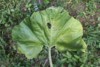
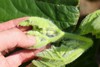
So, I have lots of problems and I'll start with this leaf shot. I recently fertilized with MKP at 1tsp/gallon sprayed over the patch - about 300 sq. ft. It triggered some toxicity, but more likely a deficiency since my research shows that this might be an iron uptake problem.
No, I don't have a soil test... And yes, I'm getting one right away. :)
Notice the chlorosis forming next to the veins, and the burning along the leaf fringe. This is occurring on new growth, and older leaves look fine.
|
|
|
Tuesday, July 28
|
View Page
|
|
Here you can see the symptom on the plant. I've removed many of these leaves since I've had wilting at the growing tips, and giving water to these leaves seems like more work for the plant that it is worth. I have left some however, to monitor their progress, and see if any possible remediation is possible once I get the soil test back.
|
|
|
Tuesday, July 28
|
View Page
|
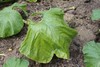 |
Not sure if the photo showed in last entry so here it is again.
|
|
|
Tuesday, July 28
|
View Page
|
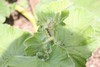 |
Even more alarming, when the yellowing started showing, almost all of the growing tips stopped growing (very slow growth at least) and you can see here that all the flowers have aborted. Males, females, all of them in the growing tips on the vines affected. Yikes!
|
|
|
Tuesday, July 28
|
View Page
|
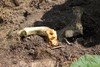 |
And... Once again, I have vine borers. Last year I was taken out in July and this year I decided to use Imadacloprid. (Trade name - Merit, also sold as Bonide Systemic) I don't want to spray a broad spectrum insecticide, so this is a good option since it is taken up by the plant and only affects insects that eat it.
I have seen good control of cucumber beetles, and I thought I would be protected from vine borers, but I suspect the application rate wasn't high enough. I will be reapplying later today.
Here you can see the stump. I thought it was a little rot -- a post on the message board alerted me to check for rot where I have cut off leaves too high. As I started scraping I started pulling out larvae. :( There weren't as many as last year, and many of them were still small.
I cleaned the stump and vine, and washed it with diluted rubbing alcohol. (91% alcohol at 1:8 or so with water)
|
|
|
Tuesday, July 28
|
View Page
|
 |
I discovered that the leaves were also being attacked. I had some over N issues early in the season and the leaves grew fast and large and several had buckled and were laying on the soil -- the stems that is.
This leaf shows what it looked like from above.
|
|
|
Tuesday, July 28
|
View Page
|
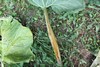 |
And here you can see the ventral side. :(
When I cut this leaf orange water just poured out of it, and you can see why. Damage this bad is caused by one or more lavae at the fourth instar. No larvae were present, so they have left the stem to pupate in the soil...
The infection has been developing for a while longer than I thought.
|
|
|
Tuesday, July 28
|
View Page
|
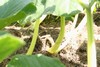 |
This shows the bend in the stem (stalk in the center of the frame) that occurred in several of the early leaves. Most of the bends were at ground level though.
I believe the damaged areas were targeted by the borers. Either because they were in contact with the soil, or because they were easier entry. Probably the former, but the latter likely made the stem just that much juicier for the moth.
|
|
|
Tuesday, July 28
|
View Page
|
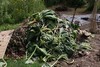 |
So, between culling leaves affected by the borers, and removing severely yellowing leaves, my compost pile had a new layer added.
|
|
|
Tuesday, July 28
|
View Page
|
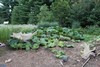 |
Here is a shot of the patch as it currently stands. It's on a bit of a rise so it goes back a little bit further. On the right side of the frame, I have been terminating those vines mainly due to space constraints.
On the left side, it has fared much better. I have had a lot of wilting and the left side gets late day shade from a nearby apple tree. It seems to have weathered all the problems much better.
You can see that the growing tips of the vines have a yellowish cast to them... Not good.
|
|
|
Tuesday, July 28
|
View Page
|
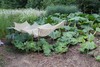 |
This shows my shade set up. Burlap cloth works really well to knock down the sun and I have a second section, taken down at the moment, that was over the main vine.
I grow bamboo, so stakes for the plant and shade cover are easy to come by. :)
|
|
|
Tuesday, July 28
|
View Page
|
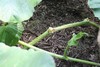 |
On a previous pumpkin attempt, the fruit was forming at a very bad angle. **Note to self and other newbies -- pay attention to vine orientations all the time.**
So I made some pretty large rotations over several days and had it lined up nicely. The stem shows the rotation. The pumpkin aborted shortly after, and it coincided with the MKP application, so I think that is the cause rather than the vine twist. The vine and stem looked fine after the rearrangement.
I was sad to see this pumpkin go since it was the best start I had this year so far.
|
|
|
Tuesday, July 28
|
View Page
|
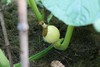 |
Not all hope is lost however. I have this gal going at the moment. 8.5" cc. at 7 DAP (I think -- notebook out in the patch right now.)
So far it looks good. It only put on .5" overnight, so I hope it will be doing better tomorrow morning.
It will be my last hope for the season since I won't be able to get another female flower for several weeks I think. With all the new flowers aborted it could be awhile.
I don't know. If the plant starts to pick back up, I might try one more time. I would be ecstatic with even a 200lb pumpkin this year. It would be worth it just to go through the motions to learn more for next year's attempt. *sigh* It doesn't look good this year however.
Maybe the soil test will shed some light that will affect my decision. And of course... Maybe this one will take! :) I'm keeping my optimism very low though. It's been a newbie struggle this year for sure.
|
|
|
Tuesday, July 28
|
View Page
|
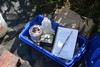 |
As a last pic for the diary start, here is my field kit. I realized I wasn't keeping records early on since the notebook wasn't with me in the patch. I added a ball of string for measuring, a tape measure for the string, some twist ties, clothes pins, a few shortie stakes and some bags. Recent additions.... A bottle with dilute alcohol, and my favorite probe for borers/rot areas.
It's a little sad to say I have a 'favorite' tool for problem areas. Still, if you have to dig and scrape, it gets the job done well.
|
|
|
Wednesday, July 29
|
View Page
|
 |
Today I noticed that some of the cuts still had some rot. I can't cover them and put a fan on them since there are so many, and it's far away from the house. I'm going to take a look at the messages and up my disinfecting. I believe Bordeaux is recommended and I have some on hand. Research first... It's going to be a hot one today, but no watering. Let everything dry out a bit.
Applied another round of Imadacloprid last night and did water it in. I now think my previous application might have been the right amount, for the pumpkin plant at that size. It got bigger of course. ;)
Bad news today - 'kin hasn't grown overnight. Still 8.5" cc. and based on the last one, this doesn't bode well for it.
Good news today - new shoots looking better and this one has a female flower on it! It's a tertiary (to fill in gaps) but I'll take what I can get at this point.
|
|
|
Wednesday, July 29
|
View Page
|
|
I should probably add a few bits about Imadacloprid, since I don't see people using it and some might be wondering about it.
Reviewing the Wiki would be a good idea for a start:
https://en.wikipedia.org/wiki/Imidacloprid
As a systemic, it provides excellent control over the entire plant since it is moved throughout the plant by the vascular system.
However, it can leach in sandy soils, but binds very well to organic matter. I suspect most growers have a high amount of organic matter in the patch, but it's a consideration.
More importantly, it is a beast on honeybees, and I suspect on other bees as well. Preventing access to flowers is very important. I've been diligent in trying to monitor for flower openings and closing them or culling them to keep bees out.
|
|
|
Wednesday, July 29
|
View Page
|
|
However, I have had four flowers escape and be open in the morning. I had around a dozen bees (a small variety of bumble bee, not the domesticated European Honey Bee) between them visiting the flower. :( I killed the bees in the first flowers to prevent them from returning to the hive. Since bees share nectar and pollen within the colony, I didn't want to them to get home. But I let some of the bees go in a couple since I didn't think they were there very long.
Reading the wiki, I won't be letting anybody go home going forward.
Take home message - it's great for control (if applied properly - see vine borer woes above) but it requires a very high responsibility. Saying that, broad spectrum insecticides can be their own problem, but if spraying when flowers are closed, pollinator exposure is very low.
I am adverse to killing non-target species so I went with Imadacloprid.
I'm an entomologist by undergrad degree, so I'm a big champion of insects in general. It made it all the more painful for me to see open flowers... I'm increasing my diligence, and I thought I would share this with other growers for educational purposes.
If you have any questions about insects or pesticides, let me know. I'm happy to help. **I did pesticide training for a little while after I graduated so I'm familiar with most insecticide classes.**
|
|
|
Thursday, July 30
|
View Page
|
 |
Well, my recent pumpkin aborted. No growth on it for 2 days, and losing its shine.
But, I have decided to trudge onward. It occurred to me that I have a lot to learn, and better to learn some of it this year rather than next year when I (hopefully) have a good pumpkin going.
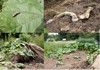
Upper left - Vine borer I missed in the stump. And area wasn't healing and now I know why.
Upper right - The stump as it stands now. I washed it with hydrogen peroxide and coated it with liquid sulfur. I had to go in and clean out some areas again - the rot was deeper than I thought. Dug it out and re-coated.
Lower left - my compost pile is growing faster than the plant right now. Found two leaves with borers that I missed, and culled almost all the leaves showing the yellowing. Figured, no need for plant to use water on them. Removed shade cover to see if lower leaf count reduces wilting.
Lower right - patch as it stands. Wow... I have several secondaries and tertiaries going fairly well and will be filling in the gaps with them.
|
|
|
Friday, July 31
|
View Page
|
 |
Today was a new symptom. Top photo shows the stump and the gelatinous ooze. I suspect this is 'stump foaming' but a moderate search on Google for a pic didn't turn up an example. Once the post is live, I'll post on the forum for confirmation.
I suspect it shows that the rot has gone deeper into the stump - probably to the core. So it was time to up my game for surgery.
Bottom left - I washed out the stump and I could see many areas had not healed - yellow and soft.
Bottome Right - My new surgery kit. Figuring scraping out the rot was leaving too much torn tissue and leaving traces of rot, I broke out the scalpel. I carved away all the damaged tissue down to clean flesh, though some areas still had a touch of yellow. (Hard to get it all and keep the stump.) Several areas meant going into the core. Odd thing - I think it will help dry out the interior.
Washed it with H202 and rinsed with dilute alcohol. Then liquid sulfur. I can see why sulfur powder would be better since it will help dry it more quickly. This old bottle of liquid is what I have on hand though. Depending on results, might step up to powdered.
If the rot goes any further it will be amputation time.
And... Found another borer today. A tiny one still, in an exposed root! That's a first. Culled more yellow leaves and it doesn't seem to be spreading. Looks like it isn't YVD, but a few more days need to be sure.
|
|
|
Sunday, August 2
|
View Page
|
 |
Well, another interesting day in the patch.
Top left - new vines are kicking in and a lot of females are showing up. Photo shows two. Looks like I can begin trying to pollinate again in a week or so.
Top Right - However, I'm still seeing yellowing, and now it has moved to some older leaves. A couple growers have now mentioned it could be YVD. It's starting to look more like a possibility. :( But I haven't fertilized in a long time and I am still waiting on my soil test results. More observation over the next 4-5 days should be interesting. I'm going to put down a tiny amount of fert tomorrow just to see if perks up the color a touch.
Middle left - Poor vine management means that I have a lot of older leaves that attach to the vine underneath. (Training differently now.) Trapping water is a concern so I put some sulfur in the stem. Good idea?
Middle Right - New SVB damage in secondary. Found some other areas as well. Watching to see if more show up over the next week.
Bottom left - Stump still showing new rot. Get out the scalpel...
Bottome right - Whoah!! Bet you haven't seen a stump like that before. :) I decided to excise all the bad tissue - and I mean all. It won't be moving much nutrients now, but I want to see if I can save it. Just to see if I can. ;) Good learning to see how much to dig in to wounds, and still get them to heal. If I can get this to heal, I can heal anything. *grin*
|
|
|
Sunday, August 2
|
View Page
|
 |
I forgot to mention a few things about the stump:
I did have some SVB still in it - small instars near soil level (original soil level that is). Hard to tell if they were still alive, but it didn't help the surgery.
The oozing along the ridge was coming from an infected run of tissue. Good to know for the future.
I found areas along the bottom that were infected also. I had to dig out a lot of soil to get at them and allow them to dry. I've found that with some other vines as well. Lesson - clear away all the soil to see what is really going on.
Another lesson - if you see infection, don't try to be merciful. Dig it all out, and do it right away. If I had been more aggressive a few days ago, it would probably have 50% more stem at this point. If I don't see nice white tissue, the scalpel goes deeper.
Start Scene -
Grower- "How is she doc?"
Doctor - "Well, the infection had gone much deeper than we expected. It was 2 and a half hours of difficult surgery. Right now she is in intensive care, listed as critical. If she can pull through tomorrow, she may make a recovery.
Grower - "So she's going to be alright?"
Doctor - "We just can say right now. But I need to tell you that we needed to remove a lot of tissue. You should prepare yourself before you see her. She will look... well... she will look different from how you remember her.
You need to stay strong right now. She's a tough nut and fighting for life with all she has. I'll let you know tomorrow if you can visit her."
Grower - "Thanks doc... I know your doing your best."
*Grower put's hands over face and turns to leave*
*soft sobbing is heard fading down hallway*
- End Scene
|
|
|
Thursday, August 6
|
View Page
|
 |
So, there is good news and bad news. Bad news first --
Yesterday I was checking my wound care and noticed I still had some soft spots in a couple of areas. (The stump was doing very well however, save a small spot underneath.) I started to trace the yellow leaves back on their vines and noticed that they led to some soft spot somewhere, either on their own vine, or at the union on the main.
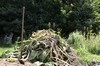
Turns out, it was more SVB. It was clear my control efforts have been inadequate. I found some more areas and decided to cull the plant back to only healthy/uninfested vines. See compost pile.
The good news is that it wasn't YVD or similar. Controlling SVB I understand, even if I failed this year. In the new grower forum I was chatting about Imadacloprid and a grower suggested a foliar spray. I hadn't considered that before, and it seems like a much better idea since you can ensure adequate dosing for the plant. Next year, that is my plan.
So for now, I reapplied granular Imadac. at a high dose. Since it binds tightly to organic matter, I feel o.k. that I won't be contaminating groundwater, etc.
I also think I had problems since I didn't work the granules into the soil. It photo-degrades quite quickly and I suspect that might have contributed to my problem. Working it into the soil, over shallow roots, over 300 ft./sq. just isn't feasible.
|
|
|
Thursday, August 6
|
View Page
|
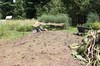 |
This photo shows what remained. Most growers would call it a season here, but I'm just crazy enough to keep going. :)
I figure it's a fresh start for the season. This year is definitely a learning year now, and this is a reboot to start again.
Lessons learned so far beyond SVB control:
Good wound care - This vine had a few tiny bad spots and I cut them out properly. No sulfur and they look great today. I have a battery powered fan, and powdered sulfur ordered.
Vine training - Ensure that the stem and secondariers are horizontal to the soil. Easier to check, cut, clean, etc.
Get a soil test - Still waiting for UMass, but important to know for balancing NPK. Worrying about deficiencies/excessive levels is an extra stress I don't need.
Train secondaries in straight line - My patch is oval so I've been winding them around, and by late season, and using tertiaries to fill, I had a knot-work going. How to step into the plant?? I will have difficulty doing that now of course, but next year...
Soil compaction - It was late when I started using 'stepping stones' for access. I really noticed areas that had compacted. A stress on the plant I don't need. Next year I will be developing 'walkways' for access.
Less grass mulch - I heard a grower say it ties up N. Not so. Research shows it's organics degrade quickly. In fact, t releases so much N that I had over-N symptoms all over the place, with no N fert. Largest leaves were over deepest grass mulch. Some leaves had diameters 2.5'+. Weak stems, flopping leaves, and more prone to PMD - saw a few spots appearing. So layers will be thin going forward.
So, with those lessons, let's see how August goes. ;) I'd be stoked to have a 50lb.+ 'kin now. Either way, I'm sure I'll learn more before the frost arrives.
|
|
|
Saturday, August 15
|
View Page
|
 |
I finally got my soil test results. Wow! Certainly no deficiencies. Seems my compost pile is over-cranked. I'm glad I got the test.
The patch is on a compost pile I have had for years. It gets all the kitchen scraps, all the flower bed cuttings fall leaves and whatever else 'plant-y' that I come across. It's been like that for years.
I grew butternut on the pile for a few years and they were enormous - 8-9lb+. I figured it was perfect for trying AGs. :) Maybe not though. The test doesn't include N, but I suspect it is just as overcharged as the other nutrients.
Since I can't remove nutrients I plan on tilling the pile into the surrounding meadow -- the soil should be fairly deficient. I need to make the patch a little larger anyway, so 'diluting' the soil should help. I'll do that this fall and send in another sample to see how it helps. I really don't want to move the patch so I'll work with it and get it under control for next season.
|
|
|
Wednesday, August 19
|
View Page
|
|
End of the season for me. But even just growing my lowly secondary provided a learning moment.
It had a wound on the (now) main vine and I cleaned it and packed it with sulfur powder. I put my new battery-operated fan on it to dry.
It was going to rain a few days later and I made a lean-to to keep it dry. Checking after the rain (it was a heavy rain), I saw that the vine was soaked. :( (Literally had a puddle in it.) Clearly I need to step up my rain protection for wounds that need to dry out. Another important lesson and glad I learned it this year. :)
So it's wait for fall for me now. Work the patch into the surrounding soil, (maybe add some additional 'poor' soil to dilute the nutrients further) and get another soil test.
Lot's of plans for next year for sure. :)
*** I should mention the fan I bought is not too bad. Fairly strong, even on low, and runs for about 6 hours on a battery. It's small enough to be able to build the rain shelter over it with the vine.
I have a few back up batteries and it's pretty easy to keep it going. Good quality 18650's can be recharged tons of times, but if you plan on swapping batteries and keeping the fan in the patch, you will need an external charger.
This is the model -
http://www.amazon.com/gp/product/B011DO2PPE?psc=1&redirect=true&ref_=oh_aui_detailpage_o03_s00
***
|
|
|
|




 MadMike - 2015 Grower Diary
