| |
|
Entry Date
|
Nick Name
|
Location
|
|
Tuesday, April 28, 2026
|

|
TowneFamilyVT
|
Vermont
|
 |
Entry 32 of 72 |
 |
|
|
|
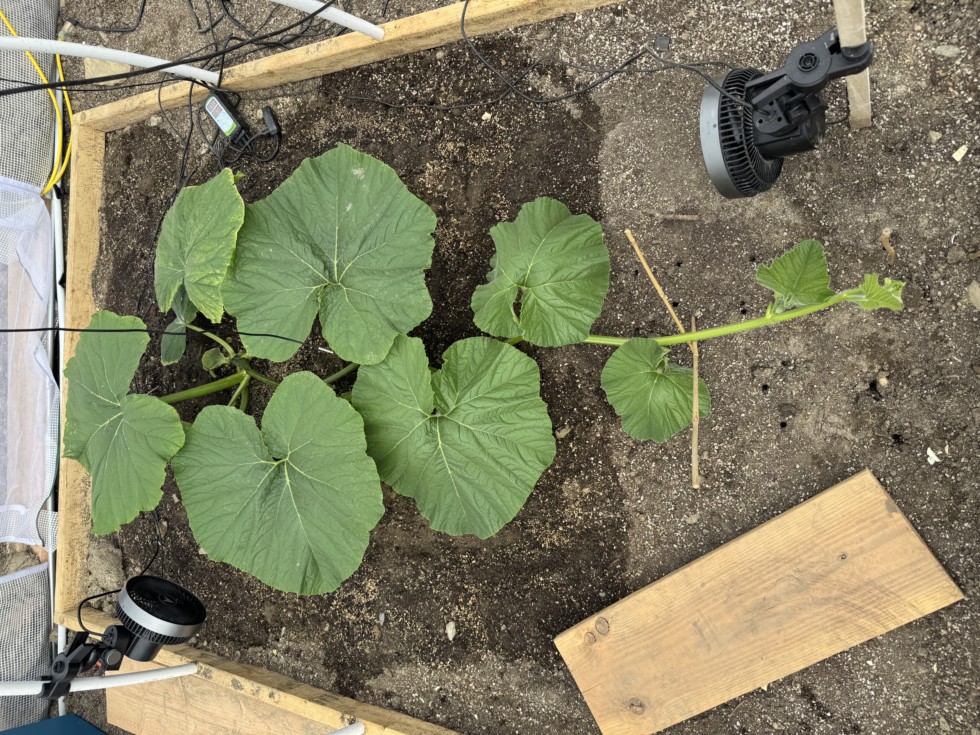
Four weeks from seed and the 2741.5 Haist is officially moving. Seven inches of vine growth yesterday, ten inches today. Main vine sitting at 5.5 feet and accelerating.
The Quictent is doing its job. I've started actively tracking air temperature, humidity, and VPD inside the tunnel using an AC Infinity sensor, which has been eye-opening. I can only control the elements so much out here in Vermont, but the data is helping me target the 0.8-1.0 kPa VPD sweet spot; the range where stomata are fully open, gas exchange is maximized, and the plant is working instead of defending. When VPD climbs above 1.2 on hot dry days, transpiration demand outpaces what the root system can deliver and growth stalls. Keeping it dialed in has made a real difference.
Drip irrigation tape goes in over the next couple of days. Until then I've been hand-watering twice daily in light spoon-fed batches to keep soil moisture consistent without oversaturating the establishing root zone.
Morning Feed:
RAW Amino Acids, Fulvic Acid, Kelp Extract, Calcium Nitrate, Companion Bacillus (Mondays), Azos Red (Mondays)
Evening Feed:
Plant Marvel 12-31-14, RAW Amino Acids, WOW 5:2 Humic/Fulvic, Epsom Salt (Mondays), Fish Hydrolysate (Tuesdays)
The split feed design is intentional. Calcium nitrate and magnesium sulfate (Epsom) cannot be mixed in the same batch. Calcium and sulfate ions combine to form calcium sulfate precipitate, locking both nutrients out of solution before the plant can access them. Running calcium in the morning feed and sulfates in the evening feed solves this cleanly while still delivering both nutrients daily.
The amino acids in both feeds aren't just an organic nitrogen source. L-glycine and L-glutamic acid specifically activate the calcium ion channels in root cell membranes, making the calcium nitrate that follows significantly more bioavailable. The sequence matters.
Biologicals go in last and right before watering. Companion Bacillus and Azos are living organisms that lose viability sitting in solution. Adding them at the moment of application rather than mixing them overnight preserves their colonization potential at the root zone.
Plant Marvel 12-31-14 deserves a mention. Beyond the NPK there's a full chelated micronutrient package; boron, iron, manganese, zinc, copper, molybdenum all in chelated form for maximum bioavailability across a wide pH range.
Running this through the drip program means the plant is getting a complete mineral profile twice daily without separate micronutrient additions. Plant Marvel's lineup will be my workhorse this year.
The fulvic acid works as a chelation and transport amplifier. It increases membrane permeability and binds mineral ions into plant-available complexes. At establishment phase I'm running it at conservative rates; it'll ramp as the root system expands and can handle the increased uptake efficiency.
Weather looks cool for the next couple of weeks which is fine by me
|
|
|