| |
|
Click on a thumbnail picture below to see the full size version.
|
4 Entries.
|
|
Monday, March 8
|
View Page
|
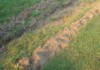 |
I would wish to invite others, newbies and all who may benefit to view this diary as a learning experience. I will include what I know and do throughout the season so others can learn as I did. Step one on my "new ground garden" is the ripping or subsoiling. The pic shows the start of this last fall. I ripped the soil by going down a shovel's length deep and putting that soil to the side. I was lucky I didn't have to remove any clay at this point. Then I turned, broke up the soil at the next deeper level, another shovels length deep, and left the soil at that depth in the trench. I did this by hand as I have no tractor or subsoiler. I did this in a checkerboard pattern across the 1300 sq.ft. garden every 3-4'. I only grow 2 plants a year. Figure about 1/2 hr. a day per plant all in all including observing for insects, disease etc. I filled the "trench" with good compost and then covered it with the soil I put to the side.
My goals:
1) To help others
2) To grow a personal best exceeding my previous best of 1242.
|
|
|
Monday, March 8
|
View Page
|
 |
COMPOST
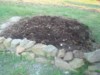
This is just 3 yds. of the type compost that I use to put on my patch. It is 2-3 yrs. old from a local horse stable with added compost of vegetable refuse, forest humus, used potting soils etc. I used about 12 yds total to start this "new ground" (used to be woods and pasture type conditions, never having been used to grow on except for a small section maybe 400 sq.ft. an old herb garden about 10 yrs. ago. I'm excited as "new ground" tends to be ideal for lack of disease and nutrient filled supersoil-like conditions. I like to keep a goal of 10% organic matter. The compost was used to fill trenches every 3 ft. in a square checkerboard pattern, and then more to spread over the garden about 3" over the entire patch. I then spread 3" of shredded leaves, mostly maple leaves, maybe 10% being other type leaves like oak, gum, sycamore and very little pine refuse. Growers often don't believe in using pine refuse but a University study found that it helps at up to a 20% rate to subdue diseases like Fusarium and other disease significantly. Good finished compost is rarely over applied at any rate, as long as you keep the OM around 10% of unbroken down material. I attempt to apply the compost all by the end of November but it's usually never too late to apply good compost. This will be all tilled in deeply (8-10") at a later spring date.I add another 3 yds. in the spring. I can't over emphasize the benefits of compost. You can find countless scientific studies to defend it's nutrient, beneficial bacterial, and disease suppressive qualities. If there's any so-called secret to growing these giants I would pick compost as
#1.
|
|
|
Wednesday, May 19
|
View Page
|
|
2010-Patch results in lower garden as of 3/31/2010:
pH- 6.9 perfect
N- 10 Goal:need come up 30 points
P- 29 too low add DAP, goal: 90-100
K- 631 high enough but will add Potassium sulfate
Mg- 251 come up some to add epsom salts
Ca- 3375 Good enough no additions here
Boron- 0.8 maybe a pinch of Borax in one of my drenches
Mn- 7.1 could come up a little, my additions of Manzeb and Symspray should increase it enough
Zn- 9.0 Zn-DL from agro-K should get it up
Cu- 0.6 Kocide sprays this season will increase it
Fe- 1.8 Way low- will spray iron or add ironite before tilling whole patch
Sulfur- 50.1 plenty
K%- 7.9 Goal: increase to 10%
Mg%- 10.0 Goal: increase to 19%
Ca%- 82.2 Goal: balance to 65%
CEC- 20.6 Great as is
Happy with overall results
|
|
|
Wednesday, May 19
|
View Page
|
|
Ammendments added to 1400 sq.ft. patch on May 5 to reach goals:
Alfalfa pellets- 30 lbs.
Potassium sulfate (0-0-50)- 7 lbs.
Corn meal- 30 lbs.
Kelp meal (North Atlantic)- 30 lbs.
Humic acid (Greensmith's)- 15 lbs.
Epsom salt- 14 lbs.
Grubex (Merit) 5 lbs.
DAP (18-46-0) 8 lbs.
Cacium lime- 4.5 lbs. 7.5' radius around point at which seedling will be transplanted as I used new soil there with 6.6 pH and projected to increase it to 6.9 based on A= pi(3.1416) x radius(7.5')squared
3.1416 x 56.25= 177 sq.ft. circle
Since 50 lbs. lime will raise soil one point in 1000 sq.ft.
therefore, 177 divided by 1000 = .177 rounded to .18 x 50= 9 lbs.. Since I only want to raise it about .5, .5 x 9 is 4.5 lbs. Just thought it might help someone figuring area watching in. Will add ironite before till to increase low iron results from test.
|
|
|
|




 Perriman - 2010 Grower Diary
